How Spotter uses context
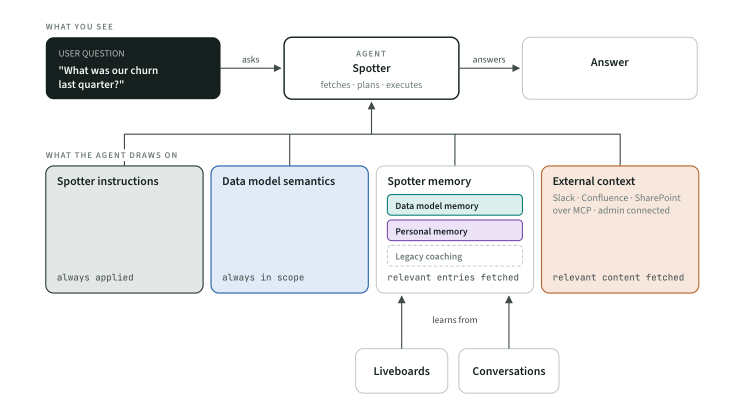
Every Spotter answer is built from four kinds of context: instructions that set behavior, data model semantics that give the data meaning, memory that establishes how your business answers, and external context from the sources your admin has connected. This page shows what Spotter fetches and how it turns it into an answer.
What Spotter assembles before it answers
| Kind | Written as | Answers the question | When it reaches the agent |
|---|---|---|---|
Behavior |
Spotter instructions, Analyst instructions |
How should the agent act, for everyone? Tone, format defaults, what to decline, what to always add |
Always, on every answer |
Meaning |
Column synonyms, column AI Context, other Model metadata |
What is this column, and how are its values written? |
Always in scope; used to pick the right columns for the words in the question |
Logic |
Data model memory, personal memory |
How does this business answer this question? Definitions, filters, steps, and what Spotter knows about you |
Fetched by relevance, per question |
Knowledge |
Connected sources such as Slack, Confluence, SharePoint |
What does this question need that lives outside ThoughtSpot? |
Searched by relevance, like memory, across the sources an admin has connected |
Memory learns from Liveboards and conversations. Row-level and column-level security sit underneath all four kinds and are never context.
Walkthrough: One question, step by step
- Neutral, concise tone. Headline number first. Prefer charts for trends.
- End every revenue or churn answer with "Figures unaudited."
- Never answer individual compensation questions. Redirect to HR.
- arr_changeARR movement · delta ARRSigned monthly ARR change per account, USD. Negative means lost revenue.
- change_typemovement typeOne of new, expansion, downgrade, churn.
- close_dateeffective dateMonth the ARR change took effect.
- fiscal_quarterquarter · FQFiscal quarter label, e.g. Q2 FY26. Fiscal year starts February.
- regiongeo · territorySales region: AMER, EMEA, APAC.
- pipeline_stagedeal stageOpen-opportunity stage from CRM.
- account_idcustomer · logoUnique customer account.
- product_skuproduct lineProduct purchased on the contract.
- account_namecustomer nameCustomer display name.
- nps_scoresatisfactionLatest NPS survey score per account.
- support_tickets_openopen ticketsOpen support tickets at month end.
- seats_licensedlicenses · seatsContracted seats per account.
- csm_ownerCSMCustomer success manager assigned to the account.
- Priya Nair, Head of Customer Success, EMEA.
- Focus this quarter: renewals and churn prevention for enterprise accounts.
- Show trends as a chart, not a table.
- When I say "my accounts", filter to EMEA enterprise accounts.
- For pipeline questions, use the Sales data model, not Finance.
- Churn = churned ARR plus downgrades:
arr_changewherechange_type in (churn, downgrade). - Quarterly churn view: filter
close_dateto the fiscal quarter, group by month, sumarr_change. - Expansion excludes price uplifts under 2%.
- "Logo loss" = count of accounts with
change_type = churn.
- confluenceQ2 FY26 renewal calendar: enterprise renewals moved to mid-quarter.
- slack#cs-emea weekly churn digest.
- sharepointCS playbook 2025.
- Columns and filters in the plan checked against the data model
- Row-level and column-level security applied for Priya
- Plan is fixed before any SQL exists
SELECT month(close_date) AS month,
  SUM(CASE WHEN change_type = 'churn'
    THEN -arr_change END) AS churned_arr,
  SUM(CASE WHEN change_type = 'downgrade'
    THEN -arr_change END) AS downgrade_arr,
  COUNT(DISTINCT CASE WHEN change_type
    = 'churn' THEN account_id END)
    AS logos_lost
FROM arr_changes
WHERE region = 'EMEA'
  AND fiscal_quarter = 'Q2 FY26'
  AND change_type IN ('churn','downgrade')
GROUP BY 1 ORDER BY 1;
| month | churned_arr | downgrade_arr | logos_lost |
|---|---|---|---|
| 2026-02 | 96000 | 28000 | 3 |
| 2026-03 | 118000 | 31000 | 4 |
| 2026-04 | 104000 | 35000 | 3 |
Churn includes downgrades, per your team's definition. March was the heaviest month: four logos and $149K.
Ten logos lost in total, all at the mid-quarter renewals set out in the Q2 renewal calendar. Say "all regions" for the global figure. Figures unaudited.
Next
-
When sources disagree: the order Spotter applies these elements when they conflict.
-
Where to write context: which surface each fact belongs on.